—
Words
Scores, sentence breakdown, and fixes will appear here once you paste.
Paste or type above. Analysis updates live.
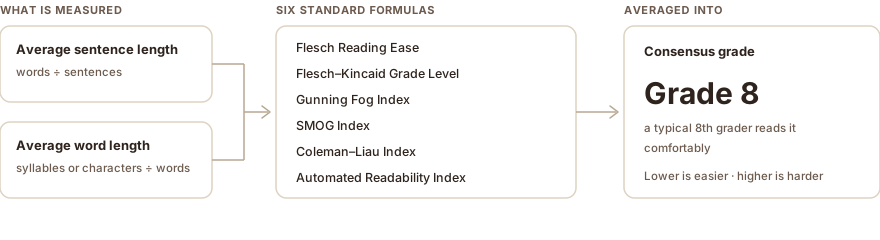
Readability scoring estimates how hard a passage of text is to read by combining two simple ideas: longer sentences are harder to follow, and longer words are harder to decode. The output is a US school grade — a score of 8 means a typical 8th grader can read your text comfortably. Lower means easier; higher means harder. A grade-level score is not the same thing as a reader's actual reading level, and it helps to know where the two diverge before you act on a number.
No single formula is definitive. This readability checker shows six standard formulas at once — Flesch Reading Ease, Flesch-Kincaid, Gunning Fog, SMOG, Coleman-Liau, and the Automated Readability Index — and averages them into a consensus grade. Differences between formulas can hint at where to look, but they are rough clues.
| Formula | What it does |
|---|---|
| Flesch-Kincaid Grade Level | US school grade from sentence length and syllables per word. Microsoft Word reports it |
| Flesch Reading Ease | A 0–100 score where higher means easier. Same inputs as Flesch-Kincaid |
| Gunning Fog Index | US grade from sentence length and the share of words with three or more syllables |
| SMOG Index | US grade from complex words per sentence. A 2013 review found it best suited to health care |
| Coleman-Liau Index | US grade from letters and sentences per 100 words, with no syllable counting |
| Automated Readability Index | US grade from characters per word and sentence length, rounded up to a whole grade |
It depends on the audience. These are the calculator's audience presets for Flesch-Kincaid grade. They are rules of thumb, not legal limits:
| Audience preset | Grade target |
|---|---|
| Children K–6 | Grade 6 or below |
| Middle school | Grade 7–8 |
| General public | Grade 7–9 |
| Legal / compliance | Grade 11 or below |
| Technical / professional | Grade 14 or below |
| Academic | Grade 16 or below |
For patient materials, the targets most often cited are 6th grade, attributed to the American Medical Association, and 8th grade, attributed to the National Institutes of Health. The US Plain Writing Act sets no grade level.
For deeper guidance, see what counts as a good readability score and how to improve your score.
The full scoring engine — syllable counting, sentence splitting, formula math — runs in your browser. We don't store, transmit, or log the text you paste. Useful for unpublished drafts, internal policy text, patient-facing material, or any content you don't want to upload to a third-party service.
A readability checker is a tool that estimates how hard a piece of writing is to read. It measures sentence length and word length, then applies formulas such as Flesch-Kincaid to give a US school grade level. Readability Check runs six formulas at once and highlights the sentences that raise your score.
Yes. Readability Check is a free readability checker with no signup, no paid tier, and no word limit on text you paste. You can also open a .docx, .pdf, or .txt file or fetch a web page; those are read up to 50,000 characters. Everything is scored in your browser.
Yes. No paid tier, no signup, no API key, no usage limit. The calculator and all six formula reference pages are free forever. The site is supported by affiliate banners on some content pages. The calculator page shows no ads.
No. Text you paste is scored in your browser and is not sent to our servers. Files you open are read in your browser too, never uploaded. If you use URL mode, our server fetches that page for you. Useful for unpublished drafts, internal policy text, patient-facing material, or any content you don't want to upload to a third-party service.
None individually. Each was built from a different sample of text and a different test of understanding. Looking at all six guards against leaning on one.
No standard sets one. This calculator's general-public preset is grade 7 to 9. Microsoft suggests around 7.0 to 8.0 for most documents.
Two edits to start with: shorten sentences over 25 words, and swap multi-syllable words for shorter alternatives. "Utilize" becomes "use"; "implementation" becomes "rollout." See how to improve your score for eight tactical edits.
Yes. See the embed page for a one-tag iframe snippet. Free forever, light and dark themes, no API key, no rate limit.
Once the page is loaded, yes — all six formulas compute entirely in your browser with no network calls. You can disconnect from the internet after the page loads and keep scoring.
Hemingway is a style coach — it flags passive voice, adverbs, and complex phrases. Readability Check is a grade-level calculator — it shows you six formulas plus a consensus grade. See vs. Hemingway for the full comparison.